Data model
A relational data model is employed. An entity-relationship (ER) diagram is shown in Figure 1.
The data is stored locally in a SQLite database (file cranio.db).
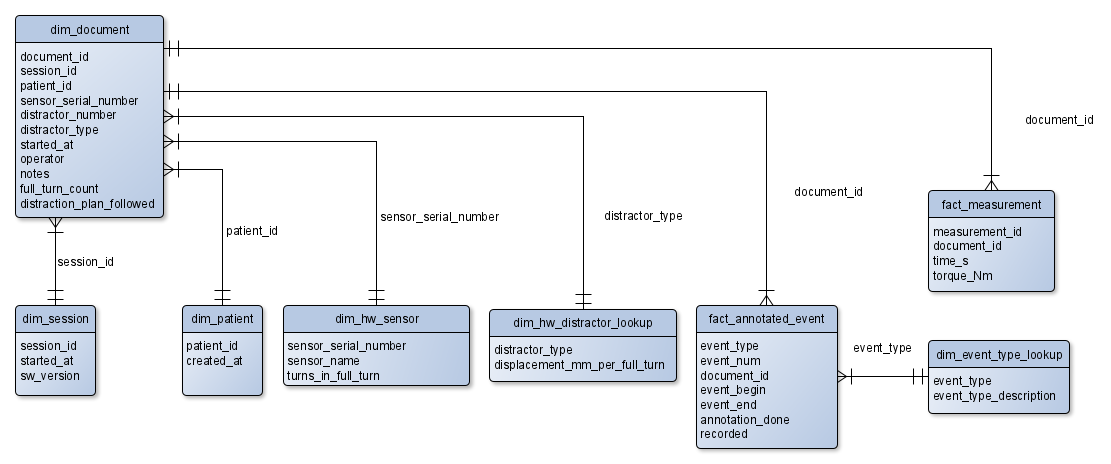
Figure 1. Entity-relationship diagram
Tables
The database tables are described in this section.
dim_session
Every time the application is launched an entry to the dim_session table is generated.
The launch date and time is stored in column started_at.
Application version string is stored in column sw_version.
dim_patient
Pseudonymized patient information. The patients are entered to the database from the application.
The person entering the patient_id is responsible for pseudonymization.
The creation date and time is stored in column created_at.
dim_document
Every time the Start button is clicked an entry to the dim_document table is generated.
The following columns are also entered at this time:
session_id: Active sessionpatient_id: Active patient (operator selects from main window)sensor_serial_number: Active sensor (operator selects from main window)distractor_id: Active distractor (operator selects from main window)started_at: Measurement start date and timeoperator: Active operator (operator enters in the main window)
The following columns are updated once the event detection has finished:
notes: Measurement notes (operator enters in the notes window)full_turn_count: Number of performed full turns (operator enters in the notes window)missed_distractors: TODO: Is this really needed?distraction_plan_followed: True/False indicating if the distraction plan was followed (operator enters in the notes window)
dim_hw_sensor
Sensor hardware information. The sensor_serial_number is automatically detected from the connected sensor.
Column turns_in_full_turn is the sensor-specific number of turns in one full turn.
dim_hw_distractor
Distractor hardware information.
Column displacement_mm_per_full_turn describes the amount of displacement generated from one full distractor turn
and is determined during hardware calibration.
fact_annotated_event
Annotated event information. The user selects regions from the measured time-torque data during event detection. Column descriptions:
event_type: Event type identifier (e.g.,Dfor distraction)event_num: Event enumerator determined from the temporal location of the event with respect to other events in the documentdocument_id: Document to which the measurements belong toevent_begin: Left region boundaryevent_end: Right region boundaryannotation_done: True/False indicating if the annotation has been done (operator enters during event detection). If False, the operator shall perform the annotation at a later time.recorded: True/False indicating if the data was recorded for the event (operator enters during event detection)
dim_event_type
Event type lookup table. Populated with the following values during database initialization:
{event_type: "D", event_type_description: "Distraction event"}
fact_measurement
Measured torque_Nm (Nm) and time_s (s) values.
Column defines document_id the document during which the data was recorded.
fact_log
Software log information. Columns:
log_id: autoincrement integersession_id: session during which the log entry was generatedcreated_at: log entry date and timelogger: logger namelevel: logging leveltrace: error tracebackmessage: log message
dim_log_level
Log level lookup table. Populated with the following values during database initialization:
{level: 50, level_name: "CRITICAL"}{level: 40, level_name: "ERROR"}{level: 30, level_name: "WARNING"}{level: 20, level_name: "INFO"}{level: 10, level_name: "DEBUG"}{level: 0, level_name: "NOTSET"}
Example SQL queries
Calculate average torque for all events:
SELECT patient_id, b.document_id, b.started_at, distractor_id, event_num, event_type, AVG(a.torque_Nm) as `avg. torque` FROM fact_measurement as a
INNER JOIN dim_document as b, fact_annotated_event as c USING (document_id)
INNER JOIN dim_event_type as d USING (event_type)
WHERE a.time_s > c.event_begin AND a.time_s < c.event_end
GROUP BY c.event_num;